Azure RTOS
An Azure embedded development suite including a small but powerful operating system for resource-constrained devices.
This browser is no longer supported.
Upgrade to Microsoft Edge to take advantage of the latest features, security updates, and technical support.
' cx='32' cy='32' r='32' /%3E%3Ctext x='50%25' y='55%25' dominant-baseline='middle' text-anchor='middle' fill='%23FFF' %3EH9%3C/text%3E%3C/svg%3E)
Hello
I was asked to quantify how many CPU cycles are required for scheduling. I'm going to do an initial development for a series of devices. Could someone guide me to a place where I can find the number of CPU cycles to do the following:
I expect the applications will run under the following:
Thanks very much
' cx='32' cy='32' r='32' /%3E%3Ctext x='50%25' y='55%25' dominant-baseline='middle' text-anchor='middle' fill='%23FFF' %3EQ%3C/text%3E%3C/svg%3E)
Hi @HugPeter-9392 Just checking back, could you please let us know if you need further help in this matter.
Please accept the helpful response as 'Answer', which will be helpful to others as well with similar questions, so that we can close this thread.
' cx='32' cy='32' r='32' /%3E%3Ctext x='50%25' y='55%25' dominant-baseline='middle' text-anchor='middle' fill='%23FFF' %3ESA%3C/text%3E%3C/svg%3E)
We don't have exact cycle counts measured, but you should be able to do that with the cycle counter hardware or an accurate simulator. Here are some sizes and timing measurements for an M7 core running at 216 MHz:
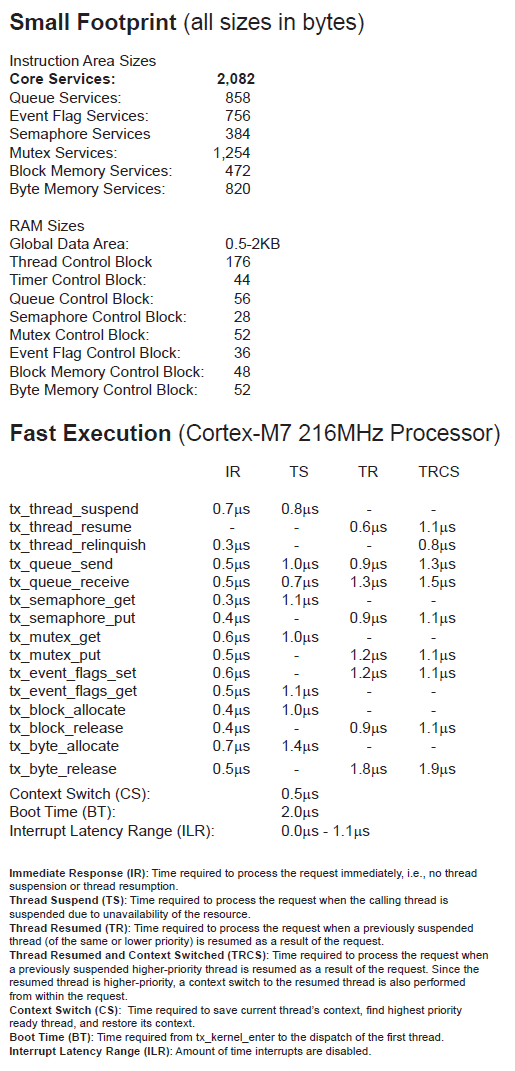
For an FPU, there will be additional cycles required to save/restore the FPU registers when context switching. For an MPU, you'll have to use ThreadX Modules, and we do not have any benchmarks for Modules yet.
' cx='32' cy='32' r='32' /%3E%3Ctext x='50%25' y='55%25' dominant-baseline='middle' text-anchor='middle' fill='%23FFF' %3EKS%3C/text%3E%3C/svg%3E)
Hi @Scott Azure RTOS ,
Could you please share the details of application(/or stack) for which you have obtained these results
Just to make sure. The total time required from end to end is the TRCS information. All other measurements are details included in TRCS.
Example:
Then the TRCS value (1.1us) gives the time beginning when thread A calls tx_semaphore_put until thread B resumes. In this situation, it is when thread B returns from its call to tx_semaphore_get.
Hi @HugPeter-9392 I think you got your thread names mixed up: the TRCS value (1.1us) gives the time beginning when thread B calls tx_semaphore_put until thread A resumes. In this situation, it is when thread A returns from its call to tx_semaphore_get.
Again, I urge you to do some benchmarking on the actual processor you intend to use. You will get different results for M0+/M4/M7. For example. the M7 has cache, while M0+ has a limited instruction set. Do you have some specific timing requirements that you must meet? Feel free to email us at azure-rtos-support@microsoft.com if you would like to discuss privately.