Note
Access to this page requires authorization. You can try signing in or changing directories.
Access to this page requires authorization. You can try changing directories.
This step-by-step troubleshooting guide can help you find and fix Microsoft Dev Box connection issues. These issues can include inability to connect, sign-in problems, frequent disconnections, or high latencies.
Prerequisites
| Category | Requirements |
|---|---|
| Tools | To create or access a dev box, an organization must set up Microsoft Dev Box with at least one project and one dev box pool. To set up Microsoft Dev Box for an organization, see Quickstart: Configure Microsoft Dev Box. |
| Tools | To connect to a dev box with the Windows App, install the Windows App on your client device. |
| Permissions | To create or access a dev box, you need Dev Box User permissions in a project that has an available dev box pool. If you don't have permissions to a project, contact your admin. |
Potential quick workaround
To automatically identify and address dev box issues, try running Troubleshoot & repair. Sign in to the developer portal and select Troubleshoot & repair from the More actions menu on the dev box tile. For more information, see Resolve connectivity issues with the Troubleshoot and Repair tool.
Troubleshooting checklist
- Verify that your client device has an active internet connection.
- Make sure your client device and dev box have the latest operating system and security updates installed.
- Ensure you have the latest Windows App installed on your client device.
- Check for any improper network configurations or internet proxy settings on your client or dev box that could disrupt remote connections.
- Confirm that your dev box status is Running. If the status is Stopped or Hibernated, select Start or Resume from the More actions menu on the dev box tile in the developer portal.
- Check Windows Update. You can't connect to a dev box for up to 30 minutes while Windows is updating.
- If you can access your dev box, review security and connection information by selecting the icons on the top connection bar during a session.
- Review known connectivity issues at Troubleshoot known Remote Desktop connectivity issues with dev boxes.
Remote connectivity issues
If the Windows App connection to the dev box hangs or fails, try the following steps to connect.
- Sign in to the developer portal and restart the dev box by selecting Restart from the More actions menu on the dev box tile.
- Once restarted, try again to connect by selecting Connect via Windows app.
- Try connecting via the browser by selecting the caret next to Connect via Windows app and then selecting Open in browser.
- Sign out and then back in to the developer portal, and try connecting again.
- Open Task Manager and terminate any running msrdc.exe or msrdcw.exe processes. Then try connecting again.
Sign-in and authentication issues
If you have sign-in or authentication issues despite using correct credentials, try the following steps:
- Use
dsregcmd.exe /statusto check your Microsoft Entra ID join status on your client device and on the dev box if possible. After resolving any errors with your support team, restart the machine. - If you don't access your dev box for a while, Microsoft Entra ID might remove your account due to inactivity. To regain access, contact your support team.
- Try using
dsregcmd.exe /refreshprtto refresh the Primary Refresh Token (PRT) for a session. Then sign out and sign back in. - If you have administrative privileges, try using
dsregcmd.exe /forcerecoveryto reauthenticate and reregister, ordsregcmd.exe /leaveanddsregcmd.exe /jointo leave and rejoin Microsoft Entra ID. For more information, see Troubleshoot devices by using the dsregcmd command. - If you have admin privileges in the Azure portal, you might need to unsubscribe and resubscribe the dev box to the dev box pool by deleting and recreating the pool.
Connection issues during high CPU load
If you experience frequent connection drops during high CPU load on the dev box, you can apply a registry setting to give more GPU priority to remote connection sessions.
Ensure your dev box has the latest Windows 11 build.
Open the Registry Editor on the dev box and add the following registry setting.
Key: HKLM\SYSTEM\CurrentControlSet\Control\Terminal Server\WinStations
Setting: SetGpuRealtimePriority
Value: DWORD 2Alternatively, you can add and set the SetGpuRealtimePriority registry setting and value by running this command in an elevated shell:
reg add "HKLM\SYSTEM\CurrentControlSet\Control\Terminal Server\WinStations" /v SetGpuRealtimePriority /d 2 /t REG_DWORDRestart the dev box.
Connection issues during low CPU usage
If you experience frequent connection drops even with low CPU usage on the dev box, you can switch your remote desktop connection to use Transmission Control Protocol (TCP) instead of User Datagram Protocol (UDP). To ensure that the connection uses only TCP, change the settings on both the client device and the dev box.
Client settings
Explicitly tell the client not to attempt a UDP connection.
- Open the Local Group Policy Editor
gpedit.msc. - Go to Computer Configuration > Administrative Templates > Windows Components > Remote Desktop Services > Remote Desktop Connection Client.
- Set the policy setting Turn Off UDP On Client to Enabled, and then select OK.
Alternatively, you can edit the registry to add the following fClientDisableUDP setting:
Key: HKEY_LOCAL_MACHINE\SOFTWARE\Policies\Microsoft\Windows NT\Terminal Services\Client
Setting: fClientDisableUDP
Value: DWORD 1
You can also apply the fClientDisableUDP registry setting and value by running the following command in an elevated shell:
reg add "HKEY_LOCAL_MACHINE\SOFTWARE\Policies\Microsoft\Windows NT\Terminal Services\Client" /v fClientDisableUDP /d 1 /t REG_DWORD
Host settings
Use Group Policy Editor to set the remote desktop transport protocols on your dev box to use only TCP.
- On your dev box, open the Local Group Policy Editor
gpedit.msc. - Go to Computer Configuration > Administrative Templates > Windows Components > Remote Desktop Services > Remote Desktop Session Host > Connections.
- Set the policy setting Select RDP transport protocols to Enabled.
- For Select Transport Type, select Use only TCP, and then select OK.
After making these changes, run gpupdate /force in an elevated shell on both machines and restart them.
Get support
If the preceding steps don't resolve your issue, you can contact your admin team, access more support resources, or file a support request.
In the developer portal, select Support from the More actions menu on a dev box tile to open the Dev box support pane. In the pane, you can:
- Select the troubleshoot your dev box link to troubleshoot dev box issues. For more information, see Resolve connectivity issues with the Troubleshoot and Repair tool.
- Select Copy support details to copy details about your dev box and an Issue ID that you can give to your admin or support team.
- Select the contact Azure help + support link to open the Azure portal Help + support page for your dev box project. On the Help + support page, you can select Troubleshoot under Actions to walk through troubleshooting steps, or select Create a support request to walk through creating a support request.
If you file a support request, include:
- A detailed description of the problem.
- The time the issue occurred.
- Impacted users.
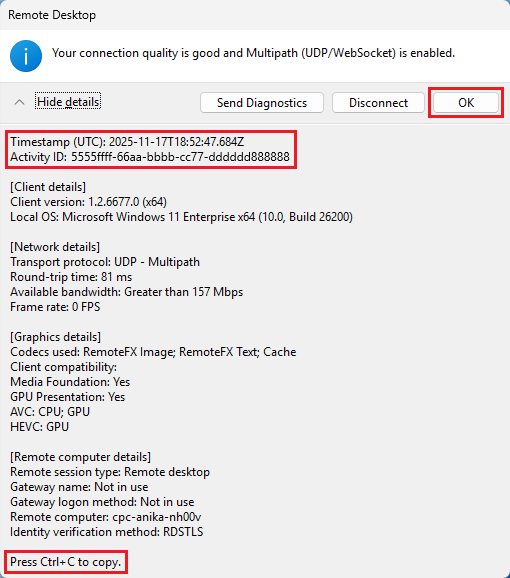
- Other information about your dev box and remote session if available, such as Activity ID.
Get dev box connection and security information
If you can access your dev box, you can get security and connection information by selecting the corresponding icon on the top connection bar during your session.

To see connection details such as Timestamp and Activity ID, select See details in the connection dialog box. Copy the connection details by pressing Ctrl+C, and close the dialog by selecting OK.