Note
Access to this page requires authorization. You can try signing in or changing directories.
Access to this page requires authorization. You can try changing directories.
The ai.generate_response function uses generative AI to generate custom text responses that are based on your own instructions, with a single line of code.
Note
- This article covers using ai.generate_response with PySpark. To use ai.generate_response with pandas, see this article.
- See other AI functions in this overview article.
- Learn how to customize the configuration of AI functions.
Overview
The ai.generate_response function is available for Spark DataFrames. You must specify the name of an existing input column as a parameter. You must also specify a string-based prompt, and a Boolean that indicates whether that prompt should be treated as a format string.
The function returns a new DataFrame, with custom responses for each input text row stored in an output column.
Tip
Learn how to craft more effective prompts to get higher-quality responses by following OpenAI's prompting tips for gpt-4.1.
Syntax
df.ai.generate_response(prompt="Instructions for a custom response based on all column values", output_col="response")
Parameters
| Name | Description |
|---|---|
prompt Required |
A string that contains prompt instructions. These instructions are applied to input text values for custom responses. |
is_prompt_template Optional |
A Boolean that indicates whether the prompt is a format string or a literal string. If this parameter is set to True, then the function considers only the specific row values from each column that appears in the format string. In this case, those column names must appear between curly braces, and other columns are ignored. If this parameter is set to its default value of False, then the function considers all column values as context for each input row. |
output_col Optional |
A string that contains the name of a new column to store custom responses for each row of input text. If you don't set this parameter, a default name generates for the output column. |
error_col Optional |
A string that contains the name of a new column to store any OpenAI errors that result from processing each row of input text. If you don't set this parameter, a default name generates for the error column. If there are no errors for a row of input, the value in this column is null. |
response_format Optional |
A string or dictionary that specifies the expected structure of the model’s response. The string values can be set to "text" for free-form text, or "json_object" to ensure the output is a valid JSON object. Otherwise, the type field can be set to "json_schema" with a custom JSON Schema to enforce a specific response structure. If this parameter isn't provided, the response is returned as plain text. |
Returns
The function returns a Spark DataFrame that includes a new column that contains custom text responses to the prompt for each input text row.
Example
# This code uses AI. Always review output for mistakes.

df = spark.createDataFrame([
        ("Scarves",),
        ("Snow pants",),
        ("Ski goggles",)
    ], ["product"])

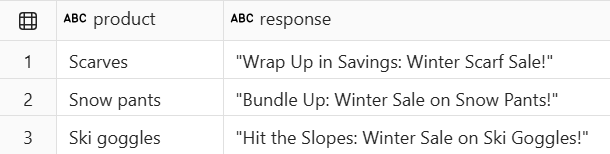
responses = df.ai.generate_response(prompt="Write a short, punchy email subject line for a winter sale.", output_col="response")
display(responses)
This example code cell provides the following output:

Response format example
The following example shows how to use the response_format parameter to specify different response formats, including plain text, a JSON object, and a custom JSON schema.
# This code uses AI. Always review output for mistakes.

df = spark.createDataFrame([
        ("Alex Rivera is a 24-year-old soccer midfielder from Barcelona who scored 12 goals last season.",),
        ("Jordan Smith, a 29-year-old basketball guard from Chicago, averaged 22 points per game.",),
        ("William O'Connor is a 22-year-old tennis player from Dublin who won 3 ATP titles this year.",)
    ], ["bio"])

# response_format : text
df = df.ai.generate_response(
        prompt="Create a player card with the player's details and a motivational quote",
        response_format="text",
        output_col="card_text"
)

# response_format : json object
df = df.ai.generate_response(
        prompt="Create a player card with the player's details and a motivational quote in JSON",
        response_format="json_object", # Requires "json" in the prompt
        output_col="card_json_object"
)

# response_format : specified json schema
df = df.ai.generate_response(
        prompt="Create a player card with the player's details and a motivational quote",
        response_format={
           "type": "json_schema",
            "json_schema": {
                "name": "player_card_schema",
                "strict": True,
                "schema": {
                    "type": "object",
                    "properties": {
                        "name": {"type": "string"},
                        "age": {"type": "integer"},
                        "sport": {"type": "string"},
                        "position": {"type": "string"},
                        "hometown": {"type": "string"},
                        "stats": {"type": "string", "description": "Key performance metrics or achievements"},
                        "motivational_quote": {"type": "string"},
                    },
                    "required": ["name", "age", "sport", "position", "hometown", "stats", "motivational_quote"],
                    "additionalProperties": False,
                },
            }
        },
        output_col="card_json_schema"
)

display(df)
This example code cell provides the following output:

Related content
Detect sentiment with ai.analyze_sentiment.
Categorize text with ai.classify.
Generate vector embeddings with ai.embed.
Extract entities with ai_extract.
Fix grammar with ai.fix_grammar.
Calculate similarity with ai.similarity.
Summarize text with ai.summarize.
Translate text with ai.translate.
Learn more about the full set of AI functions.
Customize the configuration of AI functions.
Did we miss a feature you need? Suggest it on the Fabric Ideas forum.