Note
Access to this page requires authorization. You can try signing in or changing directories.
Access to this page requires authorization. You can try changing directories.
Agent Mode allows GitHub Copilot to use the tools available in the MSSQL extension for Visual Studio Code. When the extension is installed and active, Copilot can list SQL Server connections, connect to a server and database, and retrieve database metadata.
All actions use the same connection context and credentials as the MSSQL extension. Agent Mode doesn't introduce additional authentication or permission changes.
Tip
You don't need to reference the MSSQL extension (@mssql) explicitly when using Agent Mode. If the extension is active, its tools are available automatically. For more information, see Agent Mode Tools.
For details about how Agent Mode selects and executes tools, see the Visual Studio Code documentation on Agent Mode.
What is Agent Mode?
Agent Mode lets GitHub Copilot perform SQL-related actions using the MSSQL extension, and user confirmation is required before execution.
You can invoke these actions by using chat variables such as #mssql_connect, or by issuing equivalent natural-language requests, for example:
Connect to my Library database using my LocalDev profile

MSSQL Agent Mode tool reference
This section provides a detailed reference for the SQL-specific tools available in GitHub Copilot Agent Mode. The MSSQL extension contributes these tools, enabling GitHub Copilot to execute actions through chat variables or natural language prompts. All tools require user confirmation before execution.

Tip
You can also use chat variables like #mssql_connect to invoke these tools directly, or write prompts in natural language such as:
Connect to my development database
GitHub Copilot handles tool selection automatically.
Connection management
| Tool name | Description |
|---|---|
connect |
Connects to a database by using a saved connection profile or a specified server and database. |
disconnect |
Ends the current active connection session. |
change_database |
Changes the database for an existing connection session. |
get_connection_details |
Gets connection details for a specific MSSQL connection. |
list_servers |
Lists all saved SQL Server connection profiles in your environment. |
list_databases |
Lists all available databases for a connected MSSQL server. |
Examples
Use the following phrases to interact with GitHub Copilot.
- Connect to my LocalDev environment
- Disconnect from my current database
- List my available connection profiles
- List all databases in the localhost server
- Set the active connection to localhost
- Set AdventureWorks as the active database
- Get the connection string for AdventureWorks on localhost

How connection logic works
GitHub Copilot Agent Mode supports flexible ways to connect to your SQL database, either by referencing saved profiles or by specifying a server and database directly. Here's how the connection logic works.
When you connect with a saved profile:
- You connect by referencing the name of a saved connection profile.
- GitHub Copilot uses the
mssql_list_serverstool to verify the profile exists. - The
mssql_connecttool then uses the savedprofileIdand its parameters to establish the connection.
When you connect by specifying a server and database:
If a saved profile matches both the specified server and database:
- GitHub Copilot uses
mssql_list_serversto find the match. - It then calls
mssql_connectusing the full profile.
- GitHub Copilot uses
If a saved profile matches only the server:
- GitHub Copilot finds the matching server profile.
- It attempts to connect by substituting the user-requested database into that profile.
- If the connection fails, an error is shown.
If no profile matches the specified server:
- GitHub Copilot reports an error.
This flexible matching system allows GitHub Copilot to handle a range of connection scenarios. It minimizes user effort while ensuring secure, confirmable actions.
Schema exploration
| Tool name | Description |
|---|---|
show_schema |
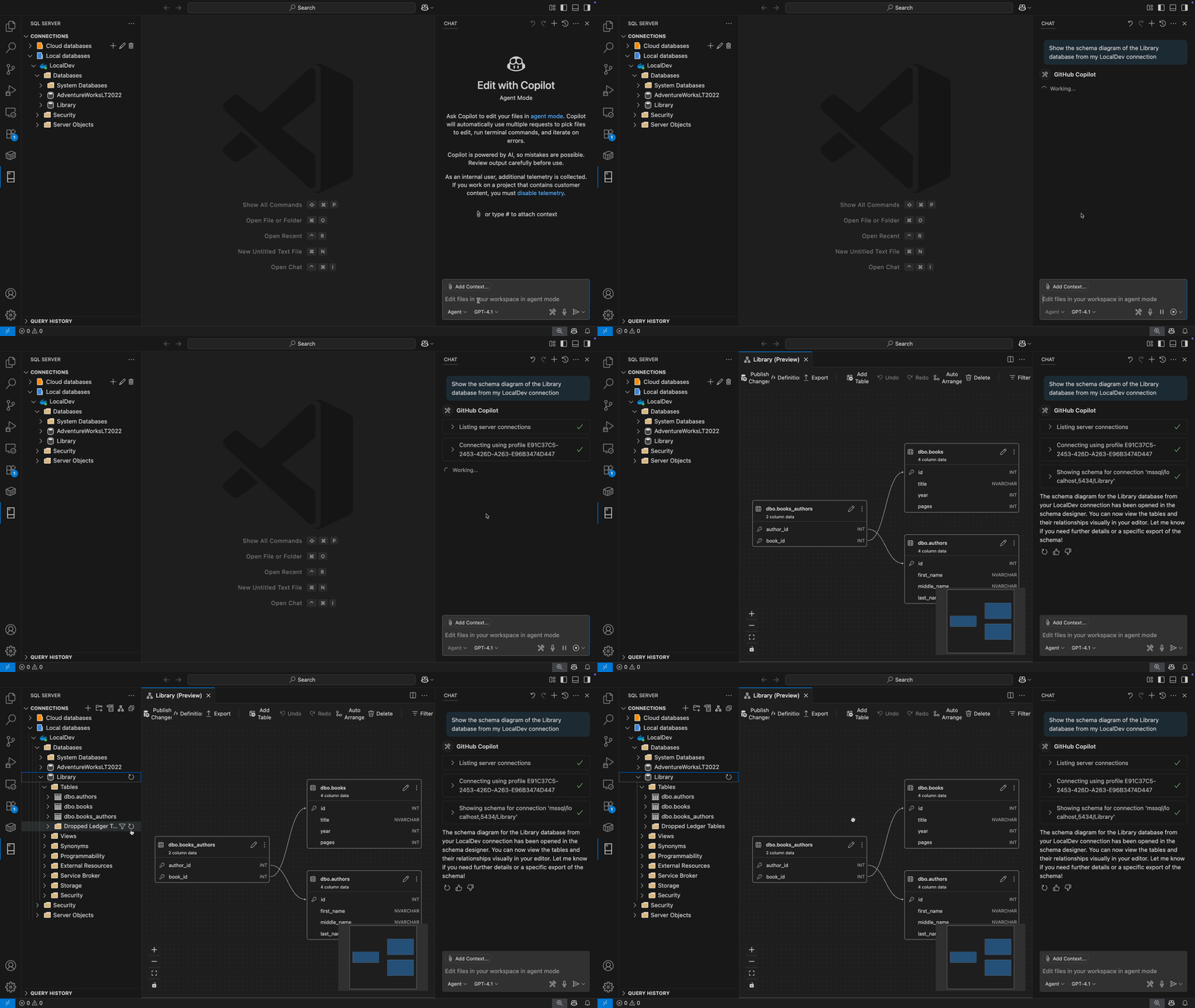
Displays a high-level diagram of your connected database schema, including tables and relationships. |
list_schemas |
Lists all schemas in a database for a connected MSSQL server. |
list_tables |
Lists all tables in a database for a connected MSSQL server. |
list_views |
Lists all views in a database for a connected MSSQL server. |
list_functions |
Lists all functions in a database for a connected MSSQL server. |
Examples
Use the following phrases to interact with GitHub Copilot.
- Show me the schema for this database
- Show me all tables in the current database
- List all views from this MSSQL database
- Give me a list of all the functions available in this schema
- What schemas are available in this database?
Query execution
| Tool name | Description |
|---|---|
run_query |
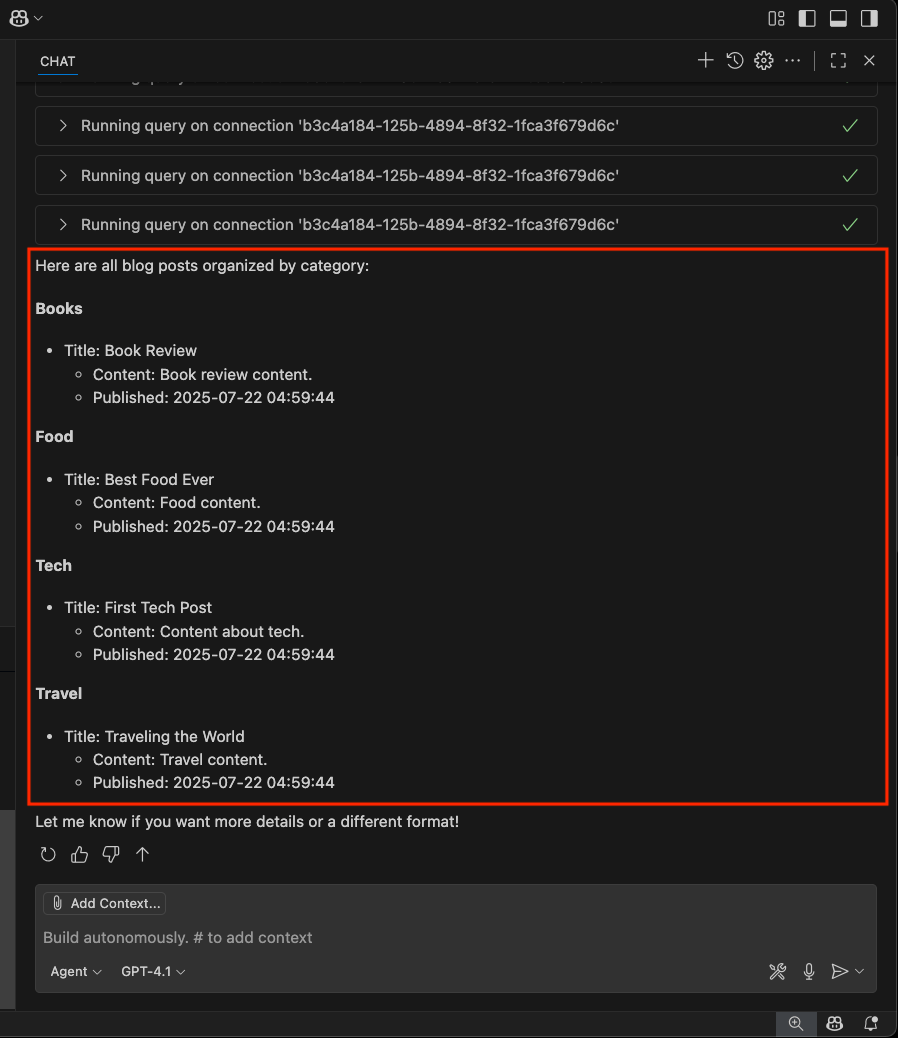
Runs a SQL query against the connected database. |
Examples
Use the following phrases to interact with GitHub Copilot.
- Give me the top five posts published this week
- Execute the current file to find how many comments each post has
- Get all categories along with the number of posts in each
How tools are managed in Agent Mode
GitHub Copilot can use MSSQL-specific tools and other extension-contributed tools while it processes your request. You can see these tools in the Agent Mode interface under the Tools menu, where you can also turn specific tools on or off.
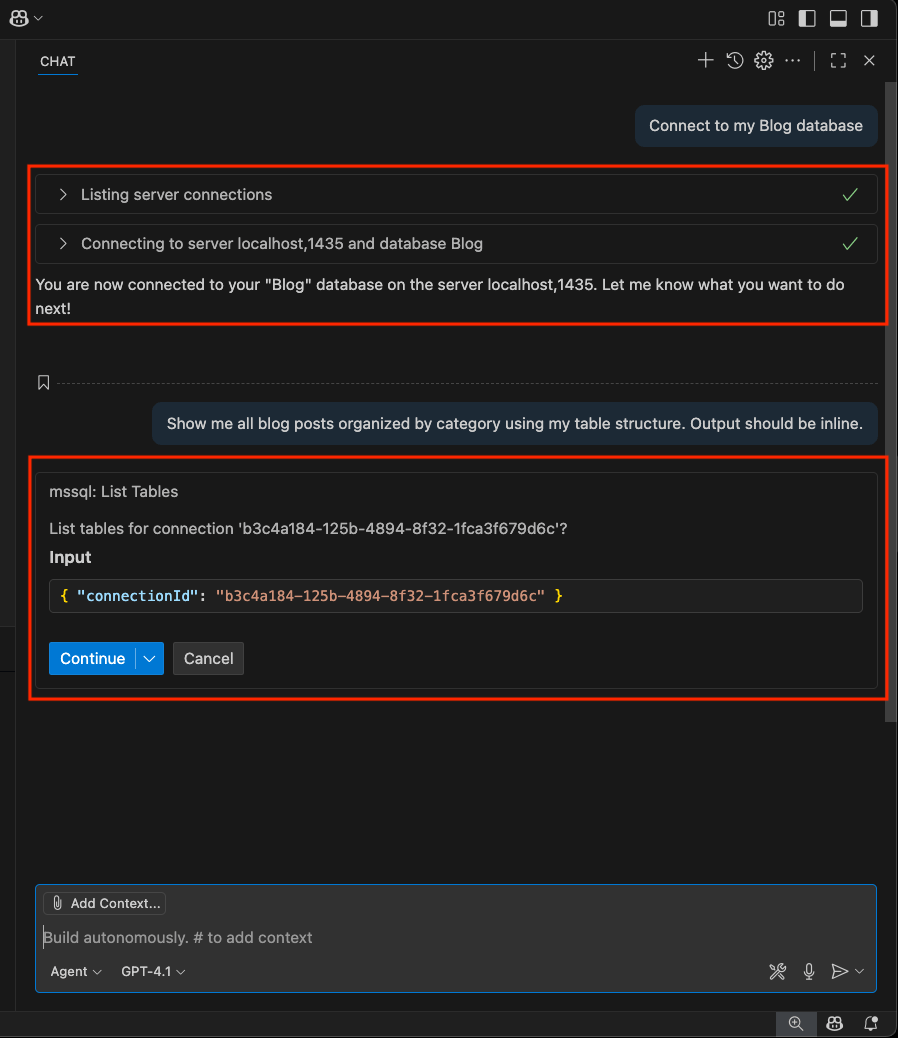
When you invoke a tool, especially if it interacts with your machine or database, GitHub Copilot asks for confirmation to ensure secure execution. You can allow the tool for just the current session, the workspace, or permanently.
For more information about tool visibility and approvals, see Manage tool approvals.
Agent Mode confirmation workflow
When GitHub Copilot selects a tool, it prompts you with a confirmation dialog that shows details about the requested action. You must explicitly approve the request before it can execute any commands that interact with your machine or database:
- Allow in this session
- Allow in this workspace
- Always allow
This confirmation step helps ensure secure, intentional interactions with your development environment.
Note
For more information on how confirmation works across all tools in Agent Mode, see the Visual Studio Code documentation on tool approvals.
Related content
- Quickstart: Use chat and inline GitHub Copilot suggestions
- Quickstart: Use GitHub Copilot slash commands
- Quickstart: Generate code
- Quickstart: Use the schema explorer and designer
- Quickstart: Use the smart query builder
- Quickstart: Query optimizer assistant
- Quickstart: Use the business logic explainer
- Quickstart: Security analyzer
- Quickstart: Localization and formatting helper
- Quickstart: Generate data for testing and mocking
- Limitations and known issues