Organize for AI success
As AI headlines showcase both breakthroughs and setbacks, the difference often comes down to how organizations structure their AI programs—the foundational layers that turn vision into sustained innovation.
The following image illustrates the organizational layers required for successful AI adoption, starting with leadership at the top and cascading down through strategy, priorities, and execution.
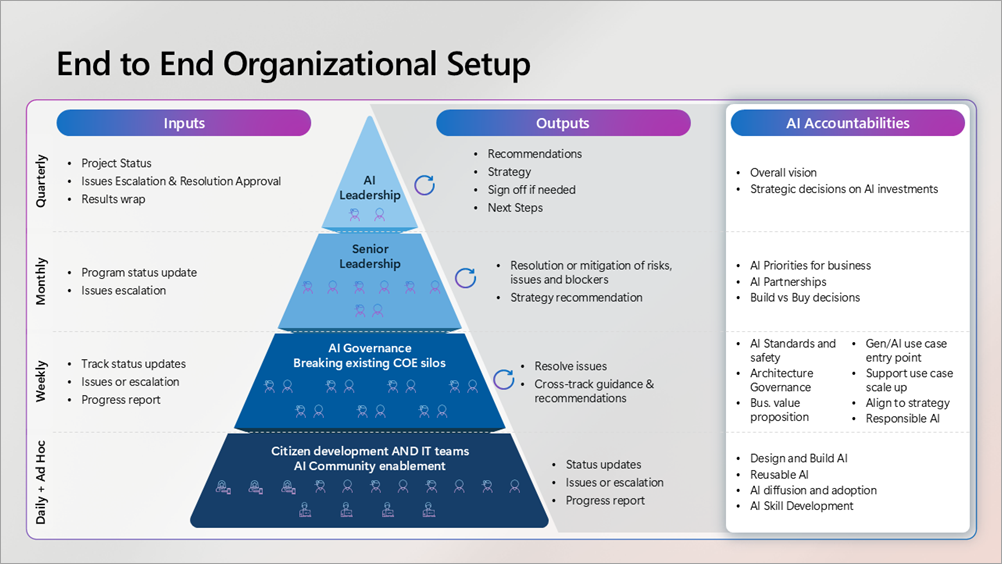
At the top, AI leadership sets a clear, end-to-end strategy and makes informed investment decisions. Senior leaders translate that strategy into actionable business priorities and partnerships, ensuring risks are managed and measurable value is delivered.
But success isn't just about top-down control. Weekly governance is essential to break down technology silos, align standards, and ensure responsible AI practices. And at the foundation, empowering citizen developers and IT teams to build, share, and scale AI solutions drives adoption and real business impact.
The key questions for every leader should be:
- Do we have a unified AI strategy, not just isolated projects?
- Are we tracking ROI and outcomes, not just spending?
- Are our Centers of Excellence truly collaborative, or stuck in silos?
- Are we enabling innovation at every level, or missing out on grassroots momentum?
Organizations that get this right avoid the pitfalls making headlines—and instead, scale AI safely, responsibly, and with measurable results.
Important
Any strategy for AI adoption needs to address your existing business capabilities. Learn more in the module Create business value from AI. The goal is to prepare your company for AI initiatives.
The question now is: within your organization, who is responsible for what tasks when it comes to AI?
Establish AI-related roles and responsibilities
AI transformation is a team effort—not just an IT initiative. Every function in your organization should have a voice in shaping how AI is applied. Encourage employees to share ideas for AI use cases and foster collaboration between business and technical teams during design and implementation. After deployment, success depends on ongoing involvement across technical and operational teams to maintain and improve solutions over time. Key responsibilities include:
- Measuring business performance and ROI from the AI solution.
- Monitoring model performance and accuracy.
- Acting on insights gained from an AI solution.
- Addressing issues that arise and deciding how to improve the solution over time.
- Collecting and evaluating feedback from AI users (whether they're customers or employees).
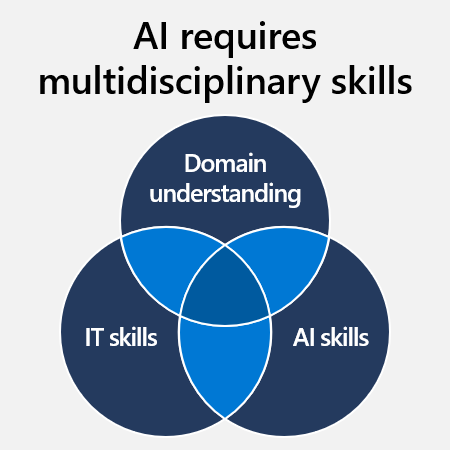
AI requires multidisciplinary skills: domain expertise, IT capabilities, and AI knowledge. Senior executive leadership ultimately owns the AI strategy and investment decisions. They set the tone for an AI-ready culture, drive change management, and establish responsible AI policies. The following table is an example of an AI Governance structure:
| Key Function | Typical Role | Key Responsibilities |
|---|---|---|
| Strategy & coordination | AI Governance Lead / Program Manager | Define AI governance frameworks, coordinate cross-functional work, report to executive leadership |
| Legal & regulatory | Legal & Compliance Representative | Ensure compliance with AI-related regulations, draft contracts and review terms, address legal risks |
| Data management & privacy | Data Governance & Privacy Lead | Oversee data governance, implement ethical data practices, ensure privacy, minimization, and anonymization |
| Cybersecurity | Security Architect / AI Security Specialist | Conduct threat modeling for AI systems, secure model data access, mitigate AI-specific threats |
| Model lifecycle & infrastructure | IT Operations / MLOps Engineer | Maintain CI/CD pipelines for AI/ML, monitor model performance and drift, ensure automated retraining |
| Risk & responsible AI | Risk & Ethics Officer | Perform AI impact/risk assessments, define risk thresholds, apply fairness, accountability, transparency (FAT) principles |
| Business alignment | Business Unit Representative(s) | Validate business value of AI, assess stakeholder impact, ensure outcomes support strategic goals |
| Model development & testing | Data Scientist / ML Practitioner | Conduct fairness/bias testing, ensure model explainability, document models |
| Training & awareness | Change Management / Communications Lead | Lead internal training on AI governance, handle stakeholder communications, promote transparent AI use |
Other leaders also play critical roles. There’s no single model for success—your organization must define a structure that fits your strategy, objectives, team composition, and AI maturity.
Line of business leader

Business leaders drive AI adoption within their function by aligning initiatives to strategic outcomes. Their role is to champion innovation and ensure ideas flow across the organization.
- Encourage employees at all levels to share AI ideas and questions.
- Identify opportunities for new business models and revenue streams enabled by AI.
- Create forums—virtual or in-person—for IT and business teams to exchange ideas.
- Train business experts as Agile Product Owners to bridge business priorities with AI development.
Chief Digital Officer

The Chief Digital Officer leads digital transformation and positions AI as a catalyst for growth. They set the vision and create momentum for adoption.
- Promote a culture of data sharing to break down silos.
- Define an AI manifesto that inspires and aligns the organization.
- Launch quick-win projects to demonstrate value and build confidence.
- Educate teams on data management best practices to ensure quality and fairness.
Human Resources leader

HR leaders shape the culture and workforce needed for AI success. They focus on readiness, skills, and change management.
- Foster a learning culture that embraces experimentation and continuous improvement.
- Develop a digital leadership strategy to build AI literacy among executives.
- Create hiring plans for specialized roles like data scientists and AI engineers.
- Design upskilling programs for technical and business teams to adapt to AI-driven workflows.
IT leader

IT leaders operationalize AI by managing technology infrastructure and delivery. They ensure scalability and governance.
- Implement Agile practices to align business and IT teams.
- Address "dark data" by cleaning and consolidating unstructured information.
- Form cross-functional delivery teams to keep AI projects connected to business goals.
- Scale MLOps practices to manage the machine learning lifecycle efficiently.
The function of business users isn't just to deliver insights to data scientists. AI must help them work better and faster. In the next unit, let's see how this goal can be achieved with no-code tools that don't require data science expertise or mediation.
Next, let's explore the potential of putting business users at the center of AI efforts.