Nuta
Dostęp do tej strony wymaga autoryzacji. Możesz spróbować się zalogować lub zmienić katalog.
Dostęp do tej strony wymaga autoryzacji. Możesz spróbować zmienić katalogi.
Ważne
Ta funkcja jest dostępna w publicznej wersji testowej.
Pamięć umożliwia agentom sztucznej inteligencji zapamiętywania informacji z wcześniejszej konwersacji lub z poprzednich konwersacji. Umożliwia to agentom dostarczanie odpowiedzi z obsługą kontekstu i tworzenie spersonalizowanych doświadczeń z czasem. Użyj usługi Databricks Lakebase, w pełni zarządzanej bazy danych Postgres OLTP, aby zarządzać stanem konwersacji i historią.
Requirements
- Instancja Lakebase, patrz Tworzenie i zarządzanie instancją bazy danych.
Krótkoterminowa a długoterminowa pamięć
Pamięć krótkoterminowa przechwytuje kontekst w jednej sesji konwersacji, podczas gdy pamięć długoterminowa wyodrębnia i przechowuje kluczowe informacje w wielu konwersacjach. Agenta można utworzyć przy użyciu obu typów pamięci.
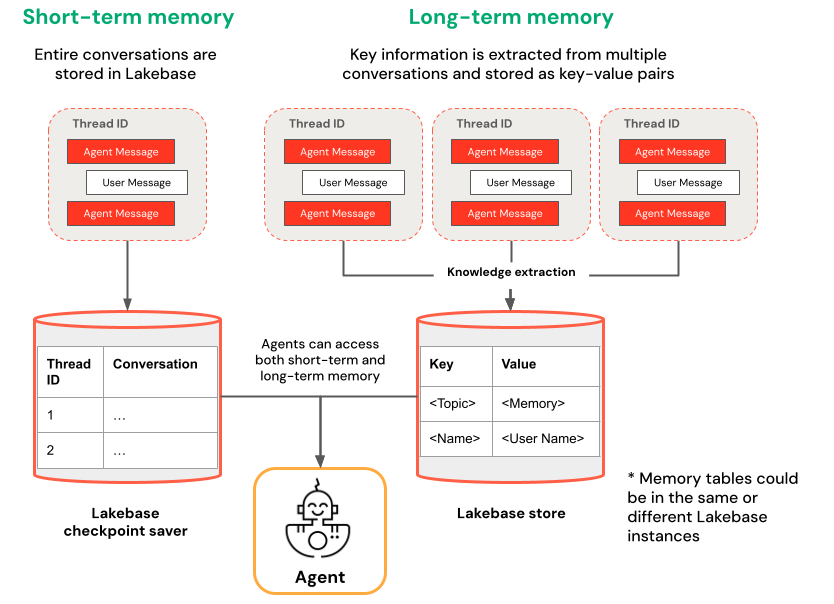
| Pamięć krótkoterminowa | Pamięć długoterminowa |
|---|---|
| Przechwytywanie kontekstu w jednej sesji konwersacji przy użyciu identyfikatorów wątków i punktów kontrolnych Zachowaj kontekst dla pytań uzupełniających w ramach sesji Debugowanie i testowanie przepływów konwersacji przy użyciu podróży czasowych |
Automatyczne wyodrębnianie i przechowywanie kluczowych szczegółowych informacji w wielu sesjach Personalizowanie interakcji na podstawie wcześniejszych preferencji Twórz bazę wiedzy o użytkownikach, która z czasem poprawia odpowiedzi |
Przykłady notatników
Agent z pamięcią krótkoterminową
Agent z pamięcią długoterminową
Wykonywanie zapytań względem wdrożonego agenta
Po wdrożeniu agenta w punkcie końcowym obsługującym model, zobacz Wykonywanie zapytań względem wdrożonego agenta Mosaic AI, aby uzyskać instrukcje zapytań.
Aby przekazać identyfikator wątku, użyj parametru extra_body . W poniższym przykładzie pokazano, jak przekazać identyfikator wątku do punktu końcowego ResponsesAgent :
   response1 = client.responses.create(
    model=endpoint,
    input=[{"role": "user", "content": "What are stateful agents?"}],
    extra_body={
        "custom_inputs": {"thread_id": thread_id}
    }
)
Jeśli używasz klienta, który automatycznie przekazuje ChatContext, np. w aplikacji Playground lub Review, identyfikator konwersacji i identyfikator użytkownika zostaną automatycznie przekazane do przypadków użycia pamięci krótkoterminowej lub długoterminowej.
Krótkoterminowe podróże w czasie pamięci
W przypadku agentów z pamięcią krótkoterminową użyj LangGraph time-travel, aby wznowić wykonywanie od punktów kontrolnych. Możesz odtworzyć konwersację lub zmodyfikować ją, aby eksplorować alternatywne ścieżki. Za każdym razem, gdy wznawiasz pracę z punktu kontrolnego, LangGraph tworzy nowe rozwidlenie w historii konwersacji, zachowując oryginał i umożliwiając eksperymenty.
W kodzie agenta utwórz funkcje, które pobierają historię punktów kontrolnych i aktualizują stan punktu kontrolnego
LangGraphResponsesAgentw klasie:from typing import List, Dict def get_checkpoint_history(self, thread_id: str, limit: int = 10) -> List[Dict[str, Any]]: """Retrieve checkpoint history for a thread. Args: thread_id: The thread identifier limit: Maximum number of checkpoints to return Returns: List of checkpoint information including checkpoint_id, timestamp, and next nodes """ config = {"configurable": {"thread_id": thread_id}} with CheckpointSaver(instance_name=LAKEBASE_INSTANCE_NAME) as checkpointer: graph = self._create_graph(checkpointer) history = [] for state in graph.get_state_history(config): if len(history) >= limit: break history.append({ "checkpoint_id": state.config["configurable"]["checkpoint_id"], "thread_id": thread_id, "timestamp": state.created_at, "next_nodes": state.next, "message_count": len(state.values.get("messages", [])), # Include last message summary for context "last_message": self._get_last_message_summary(state.values.get("messages", [])) }) return history def _get_last_message_summary(self, messages: List[Any]) -> Optional[str]: """Get a snippet of the last message for checkpoint identification""" return getattr(messages[-1], "content", "")[:100] if messages else None def update_checkpoint_state(self, thread_id: str, checkpoint_id: str, new_messages: Optional[List[Dict]] = None) -> Dict[str, Any]: """Update state at a specific checkpoint (used for modifying conversation history). Args: thread_id: The thread identifier checkpoint_id: The checkpoint to update new_messages: Optional new messages to set at this checkpoint Returns: New checkpoint configuration including the new checkpoint_id """ config = { "configurable": { "thread_id": thread_id, "checkpoint_id": checkpoint_id } } with CheckpointSaver(instance_name=LAKEBASE_INSTANCE_NAME) as checkpointer: graph = self._create_graph(checkpointer) # Prepare the values to update values = {} if new_messages: cc_msgs = self.prep_msgs_for_cc_llm(new_messages) values["messages"] = cc_msgs # Update the state (creates a new checkpoint) new_config = graph.update_state(config, values=values) return { "thread_id": thread_id, "checkpoint_id": new_config["configurable"]["checkpoint_id"], "parent_checkpoint_id": checkpoint_id }Zaktualizuj funkcje
predictipredict_stream, aby obsługiwały przekazywanie punktów kontrolnych.Predict
def predict(self, request: ResponsesAgentRequest) -> ResponsesAgentResponse:
    """Non-streaming prediction"""
    # The same thread_id is used by BOTH predict() and predict_stream()
    ci = dict(request.custom_inputs or {})
    if "thread_id" not in ci:
        ci["thread_id"] = str(uuid.uuid4())
    request.custom_inputs = ci

    outputs = [
        event.item
        for event in self.predict_stream(request)
        if event.type == "response.output_item.done"
    ]

    # Include thread_id and checkpoint_id in custom outputs
    custom_outputs = {
        "thread_id": ci["thread_id"]
    }
    if "checkpoint_id" in ci:
        custom_outputs["parent_checkpoint_id"] = ci["checkpoint_id"]

    try:
        history = self.get_checkpoint_history(ci["thread_id"], limit=1)
        if history:
            custom_outputs["checkpoint_id"] = history[0]["checkpoint_id"]
    except Exception as e:
        logger.warning(f"Could not retrieve new checkpoint_id: {e}")

    return ResponsesAgentResponse(output=outputs, custom_outputs=custom_outputs)
Przewidywanie_strumienia
def predict_stream(
    self,
    request: ResponsesAgentRequest,
) -> Generator[ResponsesAgentStreamEvent, None, None]:
    """Streaming prediction with PostgreSQL checkpoint branching support.

    Accepts in custom_inputs:
    - thread_id: Conversation thread identifier for session
    - checkpoint_id (optional): Checkpoint to resume from (for branching)
    """
    # Get thread ID and checkpoint ID from custom inputs
    custom_inputs = request.custom_inputs or {}
    thread_id = custom_inputs.get("thread_id", str(uuid.uuid4()))  # generate new thread ID if one is not passed in
    checkpoint_id = custom_inputs.get("checkpoint_id")  # Optional for branching

    # Convert incoming Responses messages to LangChain format
    langchain_msgs = self.prep_msgs_for_cc_llm([i.model_dump() for i in request.input])

    # Build checkpoint configuration
    checkpoint_config = {"configurable": {"thread_id": thread_id}}
    # If checkpoint_id is provided, we're branching from that checkpoint
    if checkpoint_id:
        checkpoint_config["configurable"]["checkpoint_id"] = checkpoint_id
        logger.info(f"Branching from checkpoint: {checkpoint_id} in thread: {thread_id}")

    # DATABASE CONNECTION POOLING LOGIC FOLLOWS
    # Use connection from pool
Następnie przetestuj rozgałęzianie punktu kontrolnego:
Rozpocznij wątek konwersacji i dodaj kilka wiadomości:
from agent import AGENT
# Initial conversation - starts a new thread
response1 = AGENT.predict({
    "input": [{"role": "user", "content": "I'm planning for an upcoming trip!"}],
})
print(response1.model_dump(exclude_none=True))
thread_id = response1.custom_outputs["thread_id"]

# Within the same thread, ask a follow-up question - short-term memory will remember previous messages in the same thread/conversation session
response2 = AGENT.predict({
    "input": [{"role": "user", "content": "I'm headed to SF!"}],
    "custom_inputs": {"thread_id": thread_id}
})
print(response2.model_dump(exclude_none=True))

# Within the same thread, ask a follow-up question - short-term memory will remember previous messages in the same thread/conversation session
response3 = AGENT.predict({
    "input": [{"role": "user", "content": "Where did I say I'm going?"}],
    "custom_inputs": {"thread_id": thread_id}
})
print(response3.model_dump(exclude_none=True))
Pobierz historię punktu kontrolnego i rozwidlenie konwersacji przy użyciu innego komunikatu:
# Get checkpoint history to find branching point
history = AGENT.get_checkpoint_history(thread_id, 20)
# Retrieve checkpoint at index - indices count backward from most recent checkpoint
index = max(1, len(history) - 4)
branch_checkpoint = history[index]["checkpoint_id"]

# Branch from node with next_node = `('__start__',)` to re-input message to agent at certain part of conversation
# I want to update the information of which city I am going to
# Within the same thread, branch from a checkpoint and override it with different context to continue the conversation in a new fork
response4 = AGENT.predict({
    "input": [{"role": "user", "content": "I'm headed to New York!"}],
    "custom_inputs": {
        "thread_id": thread_id,
        "checkpoint_id": branch_checkpoint # Branch from this checkpoint!
    }
})
print(response4.model_dump(exclude_none=True))

# Thread ID stays the same even though it branched from a checkpoint:
branched_thread_id = response4.custom_outputs["thread_id"]
print(f"original thread id was {thread_id}")
print(f"new thread id after branching is the same as original: {branched_thread_id}")

# Continue the conversation in the same thread and it will pick up from the information you tell it in your branch
response5 = AGENT.predict({
    "input": [{"role": "user", "content": "Where am I going?"}],
    "custom_inputs": {
        "thread_id": thread_id,
    }
})
print(response5.model_dump(exclude_none=True))