Observação
O acesso a essa página exige autorização. Você pode tentar entrar ou alterar diretórios.
O acesso a essa página exige autorização. Você pode tentar alterar os diretórios.
Importante
Esse recurso está em Visualização Pública.
A memória permite que os agentes de IA se lembrem de informações de conversas anteriores ou de conversas anteriores. Isso permite que os agentes forneçam respostas com reconhecimento de contexto e criem experiências personalizadas ao longo do tempo. Use o Databricks Lakebase, um banco de dados OLTP do Postgres totalmente gerenciado, para gerenciar o estado e o histórico da conversa.
Requirements
- Uma instância do Lakebase, consulte Criar e gerenciar uma instância de banco de dados.
Memória de curto prazo versus de longo prazo
A memória de curto prazo captura o contexto em uma única sessão de conversa, enquanto a memória de longo prazo extrai e armazena informações importantes em várias conversas. Você pode criar seu agente com um ou ambos os tipos de memória.
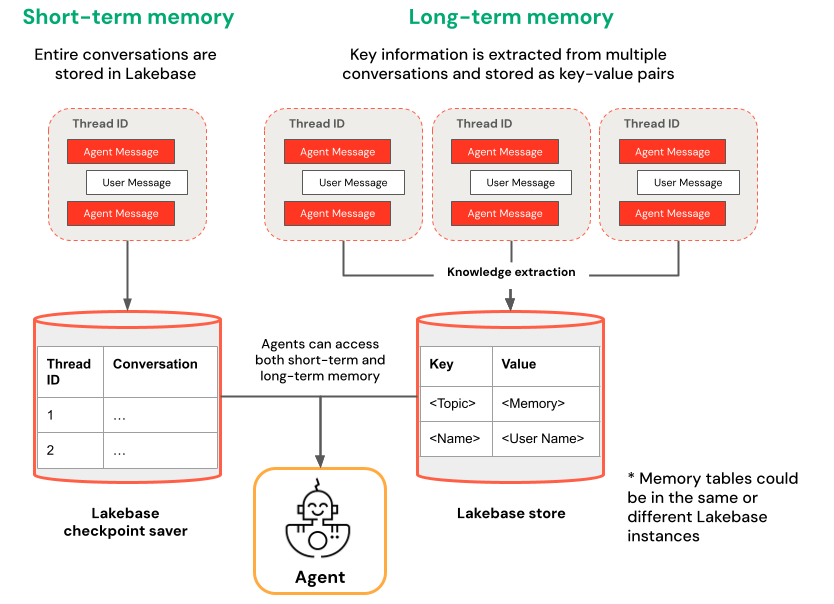
| Memória de curto prazo | Memória de longo prazo |
|---|---|
| Capturar o contexto em uma única sessão de conversa usando IDs de thread e ponto de verificação Manter o contexto para perguntas de acompanhamento em uma sessão Depurar e testar fluxos de conversa usando a viagem no tempo |
Extrair e armazenar automaticamente os principais insights em várias sessões Personalizar interações com base em preferências passadas Criar uma base de dados de conhecimento sobre usuários que melhoram as respostas ao longo do tempo |
Exemplos de notebook
Agente com memória de curto prazo
Agente com memória de longo prazo
Consultar seu agente implantado
Depois de implantar seu agente em um ponto de extremidade de Model Serving, consulte Consultar um agente de IA do Mosaico implantado para obter instruções de consulta.
Para passar uma ID de thread, use o extra_body parâmetro. O exemplo a seguir mostra como passar um ID de thread para um ResponsesAgent endpoint:
   response1 = client.responses.create(
    model=endpoint,
    input=[{"role": "user", "content": "What are stateful agents?"}],
    extra_body={
        "custom_inputs": {"thread_id": thread_id}
    }
)
Se você estiver usando um cliente que passa automaticamente o ChatContext, como o aplicativo Playground ou o aplicativo de revisão, a ID da conversa e a ID do usuário serão automaticamente passadas para casos de uso de memória de curto e longo prazo.
Viagem no tempo de memória de curto prazo
Para agentes com memória de curto prazo, use a viagem de tempo do LangGraph para retomar a execução de pontos de verificação. Você pode reproduzir a conversa ou modificá-la para explorar caminhos alternativos. Sempre que você retomar de um ponto de verificação, o LangGraph criará uma nova bifurcação no histórico de conversas, preservando o original ao habilitar a experimentação.
No código do agente, crie funções que recuperem o histórico do ponto de verificação e atualizem o estado do ponto de verificação na
LangGraphResponsesAgentclasse:from typing import List, Dict def get_checkpoint_history(self, thread_id: str, limit: int = 10) -> List[Dict[str, Any]]: """Retrieve checkpoint history for a thread. Args: thread_id: The thread identifier limit: Maximum number of checkpoints to return Returns: List of checkpoint information including checkpoint_id, timestamp, and next nodes """ config = {"configurable": {"thread_id": thread_id}} with CheckpointSaver(instance_name=LAKEBASE_INSTANCE_NAME) as checkpointer: graph = self._create_graph(checkpointer) history = [] for state in graph.get_state_history(config): if len(history) >= limit: break history.append({ "checkpoint_id": state.config["configurable"]["checkpoint_id"], "thread_id": thread_id, "timestamp": state.created_at, "next_nodes": state.next, "message_count": len(state.values.get("messages", [])), # Include last message summary for context "last_message": self._get_last_message_summary(state.values.get("messages", [])) }) return history def _get_last_message_summary(self, messages: List[Any]) -> Optional[str]: """Get a snippet of the last message for checkpoint identification""" return getattr(messages[-1], "content", "")[:100] if messages else None def update_checkpoint_state(self, thread_id: str, checkpoint_id: str, new_messages: Optional[List[Dict]] = None) -> Dict[str, Any]: """Update state at a specific checkpoint (used for modifying conversation history). Args: thread_id: The thread identifier checkpoint_id: The checkpoint to update new_messages: Optional new messages to set at this checkpoint Returns: New checkpoint configuration including the new checkpoint_id """ config = { "configurable": { "thread_id": thread_id, "checkpoint_id": checkpoint_id } } with CheckpointSaver(instance_name=LAKEBASE_INSTANCE_NAME) as checkpointer: graph = self._create_graph(checkpointer) # Prepare the values to update values = {} if new_messages: cc_msgs = self.prep_msgs_for_cc_llm(new_messages) values["messages"] = cc_msgs # Update the state (creates a new checkpoint) new_config = graph.update_state(config, values=values) return { "thread_id": thread_id, "checkpoint_id": new_config["configurable"]["checkpoint_id"], "parent_checkpoint_id": checkpoint_id }Atualize as funções
predictepredict_streampara dar suporte à passagem de pontos de verificação.Predict
def predict(self, request: ResponsesAgentRequest) -> ResponsesAgentResponse:
    """Non-streaming prediction"""
    # The same thread_id is used by BOTH predict() and predict_stream()
    ci = dict(request.custom_inputs or {})
    if "thread_id" not in ci:
        ci["thread_id"] = str(uuid.uuid4())
    request.custom_inputs = ci

    outputs = [
        event.item
        for event in self.predict_stream(request)
        if event.type == "response.output_item.done"
    ]

    # Include thread_id and checkpoint_id in custom outputs
    custom_outputs = {
        "thread_id": ci["thread_id"]
    }
    if "checkpoint_id" in ci:
        custom_outputs["parent_checkpoint_id"] = ci["checkpoint_id"]

    try:
        history = self.get_checkpoint_history(ci["thread_id"], limit=1)
        if history:
            custom_outputs["checkpoint_id"] = history[0]["checkpoint_id"]
    except Exception as e:
        logger.warning(f"Could not retrieve new checkpoint_id: {e}")

    return ResponsesAgentResponse(output=outputs, custom_outputs=custom_outputs)
Predict_stream
def predict_stream(
    self,
    request: ResponsesAgentRequest,
) -> Generator[ResponsesAgentStreamEvent, None, None]:
    """Streaming prediction with PostgreSQL checkpoint branching support.

    Accepts in custom_inputs:
    - thread_id: Conversation thread identifier for session
    - checkpoint_id (optional): Checkpoint to resume from (for branching)
    """
    # Get thread ID and checkpoint ID from custom inputs
    custom_inputs = request.custom_inputs or {}
    thread_id = custom_inputs.get("thread_id", str(uuid.uuid4()))  # generate new thread ID if one is not passed in
    checkpoint_id = custom_inputs.get("checkpoint_id")  # Optional for branching

    # Convert incoming Responses messages to LangChain format
    langchain_msgs = self.prep_msgs_for_cc_llm([i.model_dump() for i in request.input])

    # Build checkpoint configuration
    checkpoint_config = {"configurable": {"thread_id": thread_id}}
    # If checkpoint_id is provided, we're branching from that checkpoint
    if checkpoint_id:
        checkpoint_config["configurable"]["checkpoint_id"] = checkpoint_id
        logger.info(f"Branching from checkpoint: {checkpoint_id} in thread: {thread_id}")

    # DATABASE CONNECTION POOLING LOGIC FOLLOWS
    # Use connection from pool
Em seguida, teste a ramificação do ponto de verificação:
Inicie um thread de conversa e adicione algumas mensagens:
from agent import AGENT
# Initial conversation - starts a new thread
response1 = AGENT.predict({
    "input": [{"role": "user", "content": "I'm planning for an upcoming trip!"}],
})
print(response1.model_dump(exclude_none=True))
thread_id = response1.custom_outputs["thread_id"]

# Within the same thread, ask a follow-up question - short-term memory will remember previous messages in the same thread/conversation session
response2 = AGENT.predict({
    "input": [{"role": "user", "content": "I'm headed to SF!"}],
    "custom_inputs": {"thread_id": thread_id}
})
print(response2.model_dump(exclude_none=True))

# Within the same thread, ask a follow-up question - short-term memory will remember previous messages in the same thread/conversation session
response3 = AGENT.predict({
    "input": [{"role": "user", "content": "Where did I say I'm going?"}],
    "custom_inputs": {"thread_id": thread_id}
})
print(response3.model_dump(exclude_none=True))
Recupere o histórico do ponto de verificação e bifurque a conversa com uma mensagem diferente:
# Get checkpoint history to find branching point
history = AGENT.get_checkpoint_history(thread_id, 20)
# Retrieve checkpoint at index - indices count backward from most recent checkpoint
index = max(1, len(history) - 4)
branch_checkpoint = history[index]["checkpoint_id"]

# Branch from node with next_node = `('__start__',)` to re-input message to agent at certain part of conversation
# I want to update the information of which city I am going to
# Within the same thread, branch from a checkpoint and override it with different context to continue the conversation in a new fork
response4 = AGENT.predict({
    "input": [{"role": "user", "content": "I'm headed to New York!"}],
    "custom_inputs": {
        "thread_id": thread_id,
        "checkpoint_id": branch_checkpoint # Branch from this checkpoint!
    }
})
print(response4.model_dump(exclude_none=True))

# Thread ID stays the same even though it branched from a checkpoint:
branched_thread_id = response4.custom_outputs["thread_id"]
print(f"original thread id was {thread_id}")
print(f"new thread id after branching is the same as original: {branched_thread_id}")

# Continue the conversation in the same thread and it will pick up from the information you tell it in your branch
response5 = AGENT.predict({
    "input": [{"role": "user", "content": "Where am I going?"}],
    "custom_inputs": {
        "thread_id": thread_id,
    }
})
print(response5.model_dump(exclude_none=True))