Note
Access to this page requires authorization. You can try signing in or changing directories.
Access to this page requires authorization. You can try changing directories.
This article explains how to develop a business plan for AI agents that aligns your investment with organizational priorities. It guides you through identifying high-value use cases, ranking them by impact and feasibility, and defining success metrics to measure return on investment. Building this plan is the first step in the Plan for agents phase of AI agent adoption (see figure 1). Without a well-defined plan, organizations risk wasting time and resources on use cases that are poorly suited for AI agents.
 Figure 1. Microsoft's AI agent adoption process.
When not to use AI agents
The first step in identifying high-value agent use cases is understanding when not to use an agent. Agents introduce nondeterministic behavior, latency, and cost that are unnecessary for many scenarios. By eliminating unsuitable use cases early, you narrow the focus to opportunities where agents deliver measurable business value. This approach prevents wasted effort on projects better served by deterministic code or simpler AI solutions.
Structured and predictable tasks. Use deterministic code or nongenerative AI models when the workflow is predictable, rule-based, and doesn't require reasoning. If a process follows a fixed path with well-defined inputs and outputs, deterministic code or nongenerative AI models is faster, cheaper, and more reliable.
Static knowledge retrieval. Use standard Retrieval-Augmented Generation (RAG) when the goal is answering questions or generating content from a fixed index. If the workflow doesn't require tool execution or multi-step reasoning, an agent adds unnecessary complexity. Standard generative AI applications are sufficient for single-turn interactions where the system summarizes data or answers questions without orchestration. Examples include FAQ bots, document search with generative summaries, and knowledge base assistants. See RAG.
Refer to the decision tree below to assess whether your use case is suitable for an agent. If you answer "No" to the first two questions, the process likely requires the reasoning and tool orchestration capabilities that agents provide.
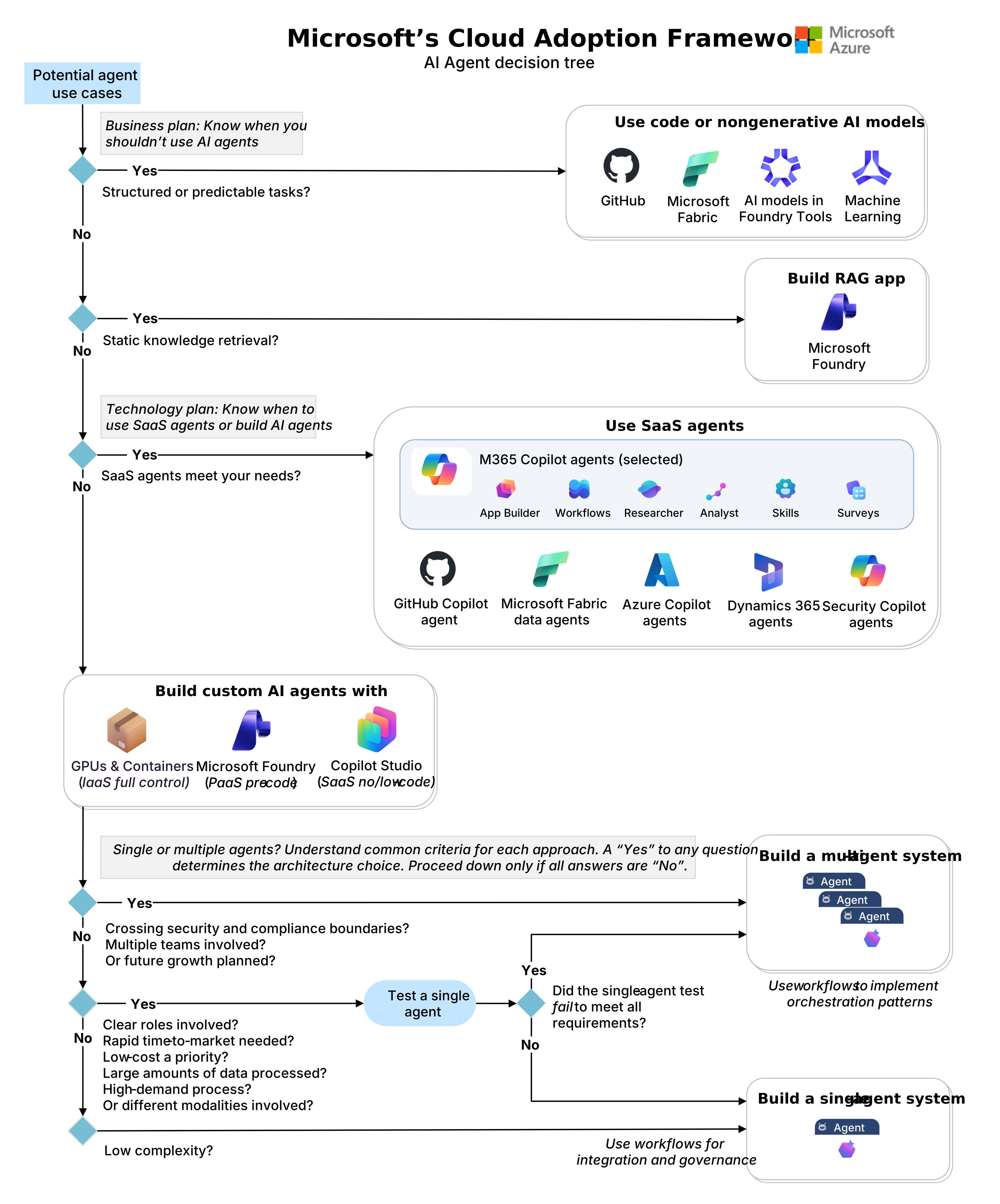
Microsoft facilitation:
For nongenerative AI solutions, see Microsoft Fabric data science. See also the prebuilt speech, language, and translator models in Foundry Tools. Build your own predictive models in Azure Machine Learning.
When to use AI agents
After eliminating unsuitable scenarios, focus on opportunities where agents drive strategic value. Unlike deterministic software that follows a fixed path, agents reason over data and tools to formulate plans. See also What is an AI agent?. To maximize return on investment, start by identifying high-impact business areas, then validate that the specific processes within those areas require the unique reasoning capabilities of an agent.
Target strategic areas. Direct agent development toward pillars that scale operations and drive competitive advantage. Aligning agent capabilities with these strategic goals ensures measurable business value.
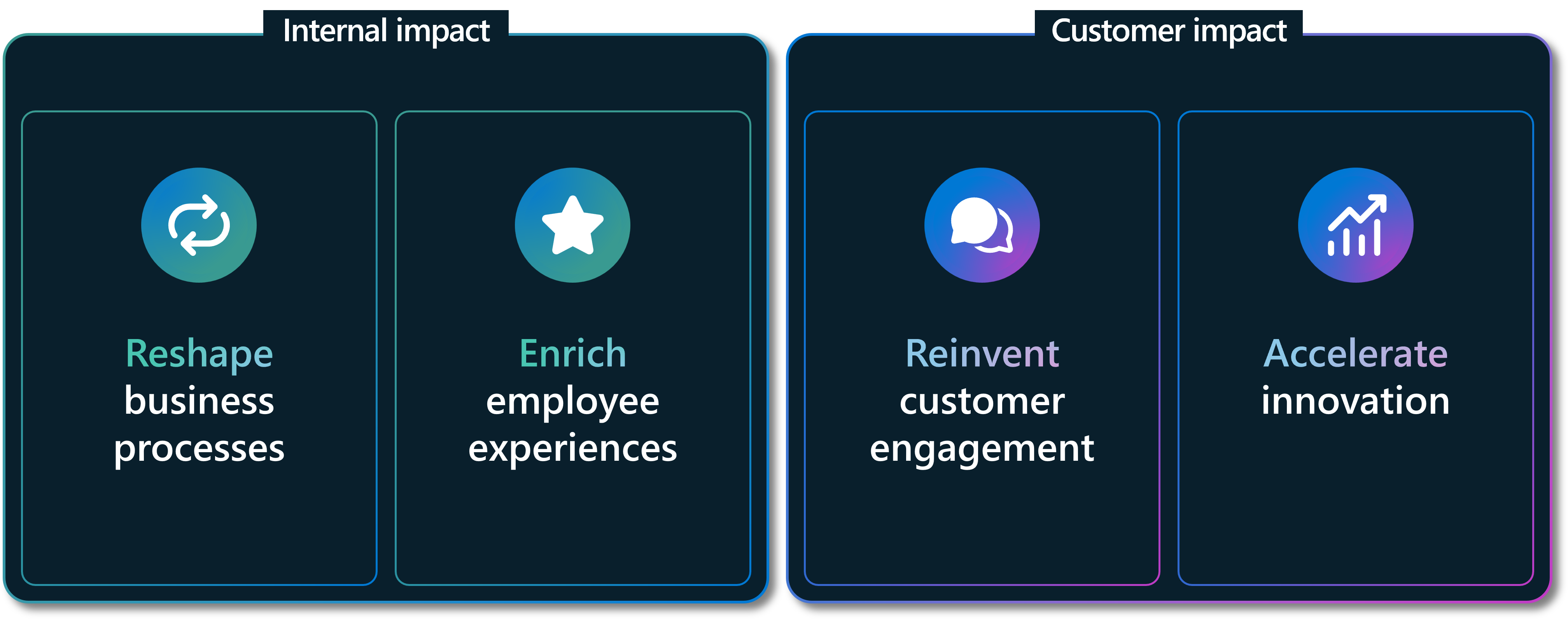
- Reshape business processes. Automate complex, multi-step workflows such as supply chain adjustments or incident triage. This scales operations without linear increases in headcount.
- Enrich employee experiences. Augment staff by handling cognitive load, such as synthesizing research or drafting technical content. This reduces cycle times and allows employees to focus on strategic decision-making.
- Reinvent customer engagement. Resolve dynamic customer queries autonomously with context-aware responses. This improves resolution speed and customer satisfaction compared to rigid chatbots.
- Accelerate innovation. Use agents to analyze market trends or simulate scenarios. This shortens product development cycles and enables faster experimentation.
Select processes that require reasoning. Within strategic areas, focus on processes where inputs vary significantly and outcomes depend on context rather than fixed rules. Agents add value when a task requires interpreting intent, reasoning through multiple steps, or selecting tools dynamically. These scenarios involve ambiguity that deterministic automation cannot handle effectively. Agents excel in the following types of tasks:
Dynamic decision-making. The process requires reasoning across multiple steps with conditional logic. The system must evaluate intermediate results and adjust its approach based on context rather than following a predetermined sequence. For example, an agent triages support tickets by analyzing ticket content, checking system logs, and escalating to specialists only when automated resolution fails.
Complex orchestration. The process chains multiple tools, APIs, or services together. The agent selects and sequences these tools based on the specific request and the results of prior actions rather than executing a static integration pattern. For example, an agent processes expense reports by extracting data from receipts, validating amounts against policy rules, querying approval workflows, and updating financial systems based on approval outcomes.
Adaptive behavior. Inputs are ambiguous or variable, and the system must interpret intent and adjust its strategy accordingly. The agent formulates a plan that responds to the nuances of each request rather than applying the same process to every input. For example, an agent handles customer inquiries by interpreting vague requests, searching knowledge bases, checking order status, and generating context-specific responses that address the underlying need rather than the literal question.
If a task fits these general criteria, an agent provides measurable value over standard automation or generative AI alone. If the process follows predictable logic with consistent inputs and outputs, use deterministic code or nongenerative AI models instead.
Validate value through rapid piloting. Test the reasoning capabilities of an agent in a low-code environment before investing in custom code. Platforms like Microsoft Copilot Studio or Microsoft Foundry allow for rapid prototyping to verify that an agent can handle the required ambiguity. This step prevents over-engineering solutions that might use simpler automation.
Microsoft facilitation:
See the Microsoft Scenario Library, AI Use Cases catalog, and Sample Solution Gallery to benchmark internal ideas against proven patterns.
How to prioritize AI agent use cases
Not all agent initiatives deliver equal value. Prioritize use cases that align with strategic goals and demonstrate impact quickly. Use three criteria to evaluate and rank candidate use cases: business impact (value), technical feasibility (complexity), and user desirability (value). See the following image for a framework on prioritizing AI agent use cases. The guidance that follows walks you through each of the criteria in more detail.

Evaluate business impact
Evaluate each use case across three dimensions using a 1–5 scale, where lower scores indicate unclear or weak business impact and higher scores indicate strong business impact:
Executive strategy alignment: Confirm whether the use case directly supports organizational priorities. If it doesn't align with business strategy, it shouldn't proceed. The strongest candidates advance strategic objectives and have visible board-level sponsorship.
Business value: Quantify the impact. Use cases with vague or unproven benefits should be deprioritized. Select initiatives that deliver measurable outcomes with clear evidence of significant value. Examples include reducing operational costs, increasing revenue, or improving customer satisfaction.
Change management timeframe: Consider the expected time and effort required to implement the use case and manage associated changes. A lengthy rollout with significant user disruption signals a challenging implementation. A short deployment cycle with minimal impact on users indicates strong feasibility and readiness.
Measure technical feasibility
Require a technical feasibility summary for each candidate use case. Include considerations such as data quality, system dependencies, integration challenges, and implementation timelines. Favor projects with short deployment cycles, minimal disruption, and strong compatibility with documented APIs or connectors. Evaluate each use case across three dimensions using a 1–5 scale, where lower scores indicate unclear or weak technical feasibility and higher scores indicate strong technical feasibility:
Implementation and operation risks. Identify and address risks upfront. If risks are unknown or mitigation plans are absent, the use case shouldn't advance. Prioritize scenarios where risks are well understood and mitigation strategies are documented and actionable.
Sufficient safeguards: Validate compliance and security measures. Lack of safeguards or unclear governance creates unacceptable exposure. Select use cases backed by mature security controls, responsible AI practices, and regulatory compliance frameworks.
Technology fit: Confirm compatibility with existing systems. If the technology requirements are unclear or poorly aligned, integration is more likely to fail. Favor solutions where the technology choice is justified, the benefits are compelling, and integration with current infrastructure is straightforward.
Measure user desirability
Gather evidence through interviews or surveys to validate pain points and openness to change. Prioritize projects with strong user advocates and minimal resistance, as AI agents succeed only when people use them consistently and trust their output. Evaluate each use case across three dimensions using a 1–5 scale, where lower scores indicate unclear or weak desirability and higher scores indicate strong desirability:
Key personas: Assess whether the key stakeholders and users affected by the use case are clearly identified. A low score means these personas aren't well understood or defined. A high score means they're clearly defined and their roles are well understood.
Value proposition: Consider the appeal and adoption potential of the use case for users. A low score reflects minimal perceived value or low interest. A high score indicates the solution is highly desired and offers clear benefits to users.
Change resistance: Evaluate the expected level of resistance to adopting the solution. A low score suggests significant resistance and challenges in managing change. A high score indicates low resistance and strong readiness for adoption.
Define success metrics
Establish measurable success criteria before development begins to ensure that agent adoption aligns with strategic business goals. Without clear metrics, organizations cannot validate whether an agent delivers the intended value or justifies the investment. These criteria serve as the benchmark for future management and measurement phases, enabling teams to track performance against initial objectives and make data-driven decisions about scaling, refining, or retiring solutions.
Set baseline business goals. Identify the key performance indicators (KPIs) that the AI agent must improve. For existing processes, measure current performance to establish a baseline. This baseline comparison enables accurate tracking of post-deployment impact. For new processes or early-stage businesses, estimate initial performance targets and refine these targets as operations mature.
Use business metrics as decision gates. Apply success criteria throughout the development lifecycle to guide investment decisions. Use these success metrics as checkpoints to determine whether the project continues, pivots, or stops. If a pilot fails to meet predefined benchmarks, reassess the use case or terminate the pilot initiative to avoid unnecessary cost and effort.
Evaluate post-deployment performance. Continue to measure success after integration. Compare actual results against target KPIs to determine whether the AI agent delivers expected value. If the AI agent underperforms, use the performance data to decide whether to refine the solution, retire the agent, or redirect resources to more promising opportunities.
This structured evaluation approach ensures that every AI agent initiative remains accountable to business value and supports continuous improvement across the portfolio.