Note
Access to this page requires authorization. You can try signing in or changing directories.
Access to this page requires authorization. You can try changing directories.
This article helps you determine whether to build a single-agent or multi-agent systems when implementing AI agent solutions. Organizations face this decision during the Build agents phase of AI agent adoption (see figure 1).
 Figure 1. Microsoft's AI agent adoption process.
Your choice affects development complexity, operational overhead, security boundaries, and integration patterns across your cloud estate.
- Single-agent systems consolidate all logic into one entity. This consolidation simplifies implementation and reduces operational overhead.
- Multi-agent systems distribute responsibilities across specialized agents. This distribution enables modularity but introduces coordination complexity. Without clear requirements for separation, the added complexity of multi-agent systems can create unnecessary complexity during development and higher maintenance effort.
Organizations that default to multi-agent architectures without validating the need often encounter higher costs, increased latency, and more failure points than necessary.
AI Agent decision tree
After deciding to build a custom AI agent, determine whether to use a single-agent or multi-agent architecture. Specific criteria drive this choice. Some requirements lead directly to multi-agent systems. Others indicate a single-agent solution. Many scenarios require testing a single agent first. Start with the least complex implementation and add complexity only as needed. Use the decision tree (see figure 2) to evaluate these criteria.
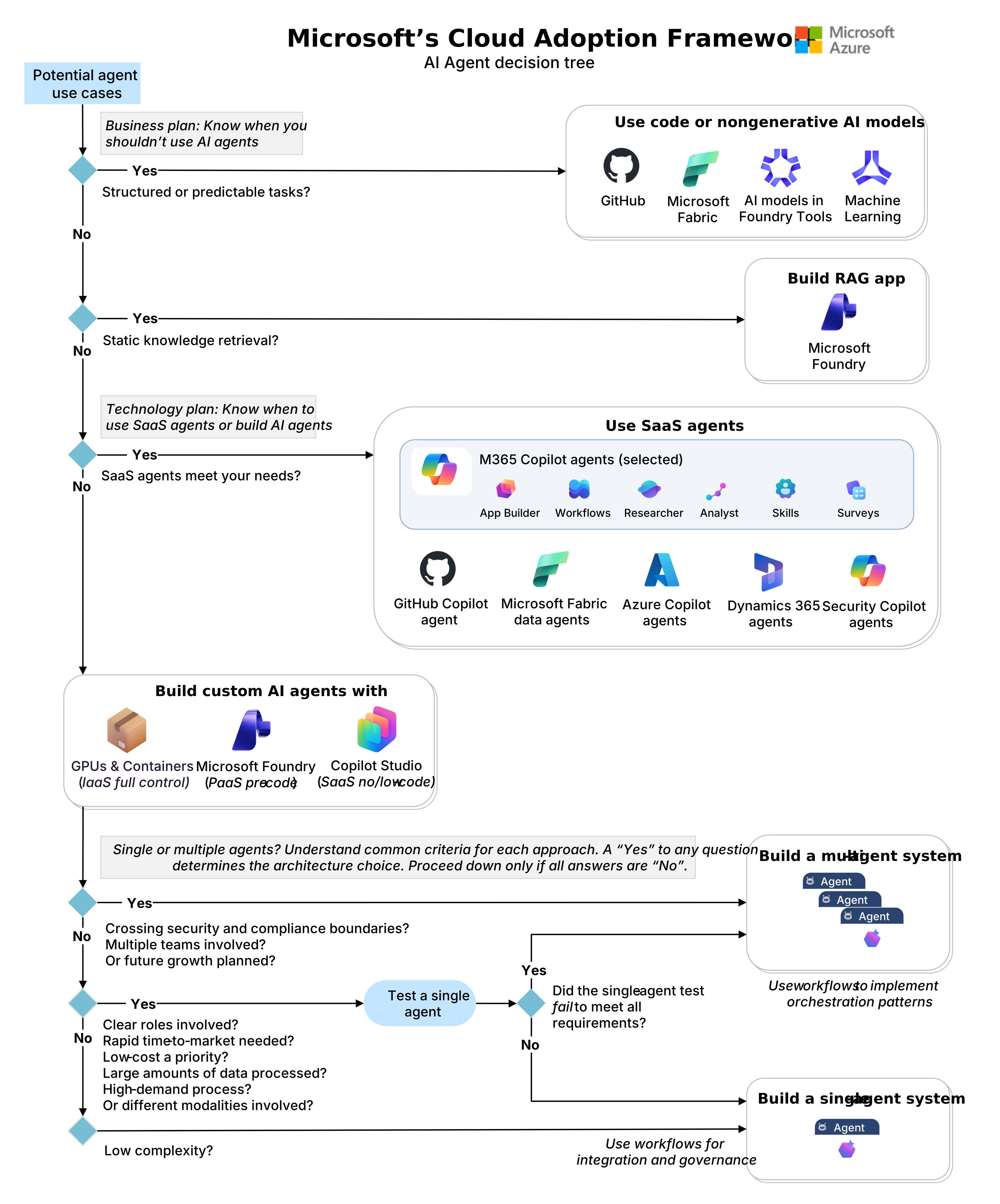
Figure 2. Microsoft's AI agent decision tree.
When to start with a multi-agent system
Multi-agent systems deploy two or more agents for distinct tasks within a single business process. This architecture enables different orchestration patterns and specialization. The coordination between agents introduces latency at each handoff point and requires explicit state management between components. Organizations should choose multi-agent architecture only when specific criteria mandate separation.
Crossing security and compliance boundaries. Build multiple agents when regulations or policies mandate strict data isolation. Different security classifications need independent processing environments that single agents can't provide. This least-privilege design limits the blast radius of security incidents by containing breaches within individual agent boundaries. Financial services often require one agent to prepare transactions while another validates them, enforcing separation of duties through architecture.
Multiple teams involved. Adopt multi-agent designs when distinct teams manage separate knowledge areas. Independent development cycles benefit from decoupled architectures where teams maintain domain-specific agents. Each team uses its specialized expertise and data sources without waiting for other teams. This alignment mirrors organizational structure and enables parallel development. Teams deploy updates independently while explicit interfaces between domains simplify governance and reduce integration risk.
Future growth planned. Choose modular multi-agent design when the solution roadmap includes diverse features, data sources, or business units. Monolithic agents become unmaintainable as responsibilities expand beyond their original scope. Separating concerns early prevents massive refactoring that disrupts operations. Solutions spanning more than three to five distinct functions benefit from this architecture. Individual agents can modernize independently without affecting the entire system, reducing upgrade risk and enabling incremental improvements.
Multi-agent orchestration and workflows
Multi-agent systems require workflows to implement orchestration patterns documented in the Azure Architecture Center. Manual chaining of agents creates brittle connections that fail unpredictably. Workflows provide structured coordination that ensures reliable agent interaction. Here are some benefits of using workflows with multi-agent systems:
| Workflow capability | Purpose |
|---|---|
| Coordination | Controls how agents interact through parallel, sequential, or conditional execution patterns |
| State management | Maintains context across agent boundaries to preserve conversation flow and data integrity |
| Branching logic | Routes requests to appropriate agents based on conditions, enabling escalation from chatbots to specialized agents or human support |
| Transparency | Provides visibility into information flow for debugging and compliance auditing |
See Orchestration strategy for technology-specific implementation options.
Multi-agent system trade-offs
Each agent interaction requires protocol design, error handling, and state synchronization. Every component needs separate prompt engineering, monitoring infrastructure, and debugging capabilities. Security surfaces expand through extra credential management and data transit points between agents. Cost structures increase because each agent processes redundant context and communication overhead multiplies with agent count. Latency accumulates at each handoff point, potentially degrading user experience.
When to test a single agent system first
Teams often assume multi-agent architectures are necessary based on untested beliefs about complexity or performance requirements. This assumption leads to unnecessary overhead and delayed delivery. For scenarios with the following criteria, start with a single-agent prototype to establish baseline capabilities. Move to multi-agent architecture only when testing reveals specific limitations that can't be addressed through single-agent optimization.
Clear roles involved. Test a single agent using persona-switching or distinct system prompts before building separate agents. Multi-agent designs become necessary only when strict security boundaries or distinct organizational ownership make unified agents impossible. Single agents can handle most role-based requirements by adjusting behavior based on user context or request type.
Rapid time-to-market needed. Deploy single-agent prototypes to validate business value and gather user feedback quickly. This approach reduces initial development time and enables rapid iteration. Multi-agent architectures introduce coordination complexity that delays initial deployment and slows feature updates.
Low-cost a priority. Single-agent designs reduce token usage and API calls by maintaining context within one entity. Validate cost benefits through prototyping before adding orchestration overhead. Multi-agent systems multiply expenses through redundant context processing and inter-agent communication that can exceed budget constraints.
Large amounts of data processed. Test whether single agents with Retrieval-Augmented Generation (RAG) or extended context windows handle required data volumes. Multi-agent architectures become necessary only when context degradation or hallucination occurs during load testing. Efficient data retrieval strategies often resolve capacity issues without architectural complexity.
High-demand process. Measure throughput and latency with single agents under production loads. Multi-agent architectures provide value only when parallelization delivers measurable performance gains. Coordination overhead can negate concurrency benefits in many scenarios, making single agents more efficient.
Different modalities involved. Start with multimodal models that handle text, images, and other formats within one agent. Use specialized agents only when specific modalities require distinct optimization that general models can't provide. Complex image analysis or real-time audio processing sometimes justifies dedicated agents with specialized resources.
When to use a single agent system
Single-agent architectures consolidate logic, context, and tool execution into one entity. This consolidation reduces design complexity, simplifies implementation, and streamlines governance. Organizations can focus on business value rather than orchestration mechanics. Single agents provide the most efficient starting point for low complexity use cases.
Well-defined problem domains. Choose single agents when workflows follow predictable patterns within bounded contexts. This approach keeps systems maintainable and accelerates development cycles. FAQ bots answering from specific knowledge bases or assistants executing fixed API sequences represent typical single-agent scenarios.
Operational efficiency matters. Single agents eliminate inter-agent communication protocols that introduce latency and failure points. Debugging becomes straightforward when all logic resides in one place. Maintenance teams can trace issues without navigating complex agent interactions or distributed logs.
Single-agent workflows
Single agents often respond directly to user requests without orchestration. Workflows provide essential structure for reliability and enterprise integration even with single agents.
- Repeatability. Workflows execute consistent tasks across inputs without manual intervention. Nightly batch summarization or scheduled report generation requires workflow automation around single agents.
- System integration. Route agent outputs to downstream systems through workflow connectors. Workflows trigger actions including sending results to SharePoint, posting notifications to Teams, or writing data to enterprise databases.
- Governance and compliance. Implement logging, approval gates, and audit trails through workflow capabilities. These controls satisfy regulatory requirements and provide operational visibility into agent decisions.
- Human review. Insert checkpoints where people validate agent outputs before downstream execution. This human-in-the-loop pattern maintains quality while preserving automation benefits.
See Orchestration strategy for technology-specific workflows implementation options.
Single-agent system trade-offs
Context length limits restrict information volume that agents process simultaneously. Broad functionality requirements complicate least-privilege security because single agents need permissions for all potential actions. Complex domains can overwhelm single agents, leading to decreased accuracy or increased response times as context grows.
Decision framework
| Approach | Use when | Skip prototyping | First step |
|---|---|---|---|
| Single agent | Domain remains narrow, unified context required, speed priority, cost constraints exist | Yes, proceed when scope stays simple and delivery urgency dominates | Deploy single agent with required tools and iterate based on usage |
| Comparative prototype | Architecture decision unclear, need evidence for context handling, role separation, or performance | No, prototyping provides decision evidence | Execute controlled tests comparing architectures against defined success metrics |
| Multi-agent | Hard boundaries exist for security, compliance, or organizational separation, guaranteed multi-domain scaling required | Yes, proceed when requirements mandate architectural separation | Design isolated agents with scoped access and explicit interface contracts |